Born in 1936 in Emet, Kütahya, Turkey. He graduated from Ankara Atatürk High School in 1954. In 1961, he earned a degree in Geology from the University of Munich, his first profession. Between 1965 and 1967, he worked as a Research Geologist at the Ankara Mineral Research and Exploration Institute. In 1967–1968, he served as an instructor of German at Hacettepe University in Ankara.
In 1970, he received the Turkish Language Association Translation Award for Ecce Homo by Friedrich Nietzsche. He graduated from the University of Rome with a degree in Philosophy in 1974, marking his second profession. Between 1974 and 1977, he taught Mathematical Logic at the Universities of Rome and Siena. In 1978, he completed his doctorate in Mathematics at the University of Tübingen (Thesis: Untersuchungen über die Metamathematik der Ackermannschen Mengenlehre).
From 1978 to 1990, he taught at a teacher training college in Lüneburg, Germany (now a university), where he conducted research on Mathematical Intelligence.
He returned to Turkey in 1990. After years devoted to poetry and translation, Can Alkor passed away in 2024.
Books
- Kül ve Yaldız: Toplu Şiirler ve Çeviriler (2024, Norgunk)
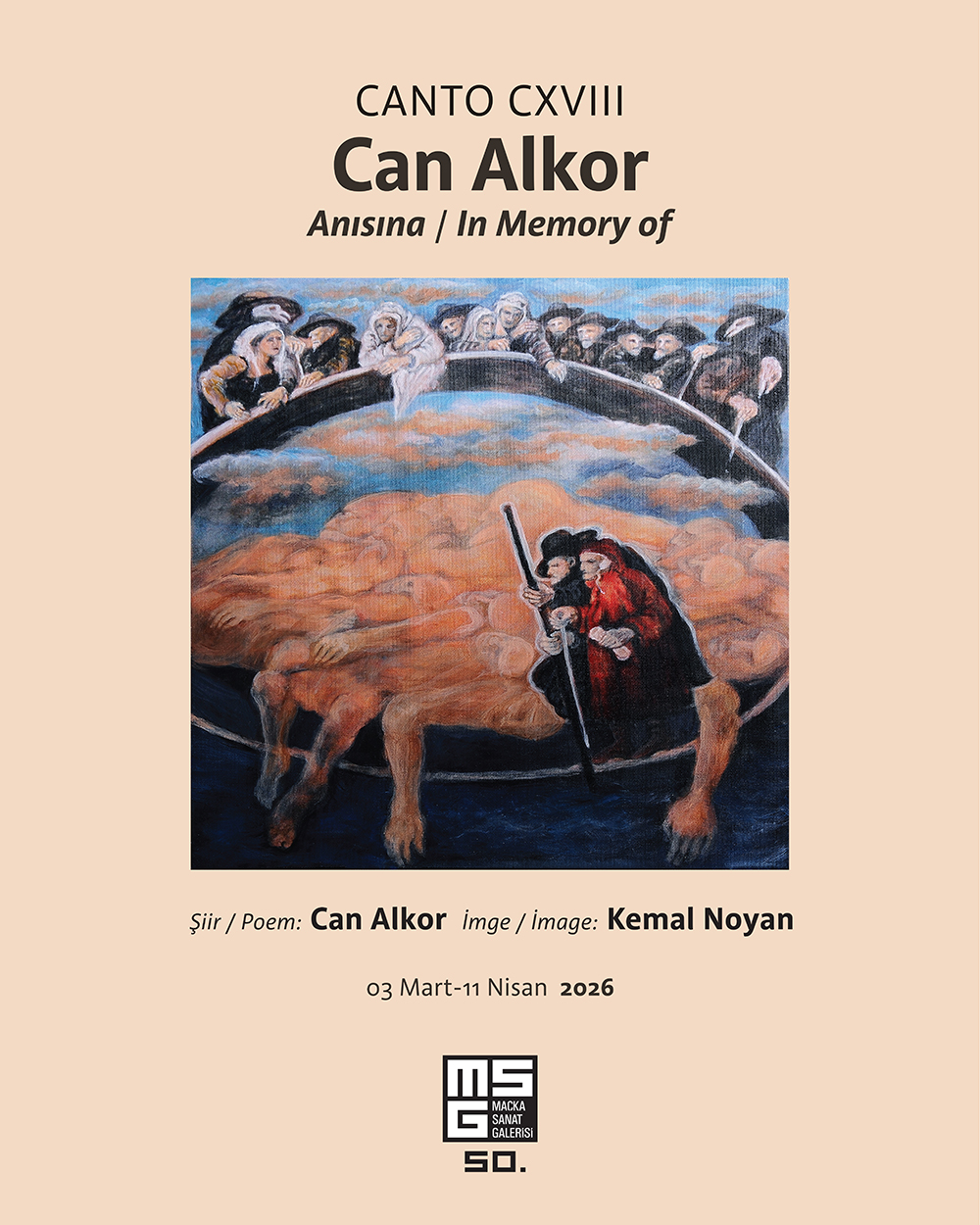
- Canto CXVIII (2023, Bilge Alkor Art Collection)
- Yasa Önünde (2021, Bilge Alkor Art Collection)
- Güneşdil & Canto CXVIII (2016, Norgunk)
- Canto CXVIII (2014, Norgunk)
- Güneşdil (2007, Türkiye İş Bankası Cultural Publications)
Book Translations
- Collected Translations (2021, Norgunk)
- Friedrich Nietzsche: Ecce Homo: How One Becomes What One Is
- Yapı Kredi Publications (2000), Türkiye İş Bankası Publications (2009), Norgunk (2020)
- Rainer Maria Rilke: Duino Elegies
- İyi Şeyler Publications (1993), Türkiye İş Bankası Publications (2006), Norgunk (2020)
- Arthur Rimbaud: Les Illuminations (2023, Norgunk)
- Arthur Rimbaud: After the Flood (Sanat Press, 1964; İyi Şeyler Publications, 1996)
Magazines Publishing His Poems
- Aç Yazı: “Journey”, “To Those Who Hosted Us in Bozburun”, “Before the Law”, “Levh-i Mahfuz”, “Visiting Orhan Veli”, “From the Drawer of an Unread Poet”, “From the Island of the Dead”, “Unknown Poet Monument”, “Lament”
- kitap-lık (1998)
- Gösteri (1991)
- Argos (1989)
- Soyut (1967–1968)
Translations Published in Magazines
- Rainer Maria Rilke, “Ninth Elegy”
- Eugenio Montale, “The Customs House”
- Friedrich Nietzsche, “Night Song”
- Carl Gustav Jung, “Second Sermon, Third Sermon”
- John Keats, “La Belle Dame sans Merci”
- Friedrich Nietzsche, “Letter to Jacob Burckhardt”
- Paul Valéry, “The Sea Burial”
- Rainer Maria Rilke, Duino Elegies (Soyut, full-text publication series, 1967)
- Selected Poems from Saint-John Perse (Soyut, 1967)